Waste Management Equipment for Municipalities: Cut Hauling Costs and Hit Diversion Targets


Most municipalities are managing waste the same way they did twenty years ago: collect it, haul it, dump it, pay the bill. The problem is that every part of that equation is getting more expensive.
Landfill tipping fees have been climbing steadily across the country. Hauling contracts renew higher every cycle. State-mandated landfill diversion targets are getting stricter, and the penalty for missing them is real. Meanwhile, storm events are generating more debris volume, and green waste programs are expanding without the equipment to support them efficiently.
The departments finding relief are not the ones that negotiated better contracts. They are the ones that changed what they send to the landfill in the first place.
Why Tipping Fees and Hauling Costs Are the Right Problem to Solve
Hauling and tipping are charged by weight or volume. That means every ton or cubic yard you process, reduce, or divert on-site before it leaves your facility is a direct cost reduction on the back end.
A municipality hauling ten loads a week to a regional landfill at $80 per ton is not just paying for disposal. It is paying for driver time, fuel, truck wear, and the administrative overhead of scheduling. Reduce that to seven loads by processing material on-site first, and the savings show up immediately and compound every week of the year.
On-site volume reduction through shredding, chipping, or compaction is not a capital project with a ten-year payback. For most departments, the right machine covers its own cost within the first operating season.
Industrial Shredders: Reduce Volume Before It Costs You
For municipalities handling construction and demolition debris, bulky waste, or mixed solid waste at a transfer station, an industrial shredder is the most versatile volume reduction tool available.
Slow-speed, high-torque shredders process mattresses, furniture, pallets, wood waste, light metals, and general bulky waste into a fraction of their original size. A 3:1 volume reduction is typical. That means three loads becoming one before anything hits the road.
The economics are straightforward. If your transfer station is receiving 200 tons of bulky waste per month and paying $70 per ton to haul and tip it, you are spending $14,000 a month on that material stream. Shred it on-site and you are hauling a third of the volume. The machine payment comes out of that delta.
Shredders also support downstream sorting and recycling. Reducing particle size makes it easier to separate ferrous metal with a magnet system, cardboard with an air separator, or wood fiber for composting. Municipalities running diversion programs find shredding upstream makes every downstream process faster and more effective.
For a full breakdown of shredder types and how to match throughput capacity to your operation, see our industrial shredders guide.
Trommels and Screeners: Turn Green Waste Into a Product
Many municipalities have expanded green waste collection without building the back-end infrastructure to do anything useful with it. Material sits in windrows, turns slowly, and gets hauled off as low-grade compost or landfill fill when it does not meet quality standards.
A trommel screen changes that equation. Trommels are rotating drum screens that separate finished or near-finished compost from oversized material, rocks, and contaminants. They are built for wet, sticky, and irregular material that flat deck screeners cannot handle cleanly.
A well-run municipal composting program using a trommel can produce consistent, market-grade compost that either commands a sale price or eliminates the cost of purchasing soil amendment for city parks, roadside restoration, and public landscaping. Some municipalities give it away to residents as a cost of service and eliminate the hauling line item entirely.
The key is throughput. A trommel sized correctly for your green waste volume will process your windrows in hours, not days, and free up equipment and staff for other work. Undersizing is the most common mistake; a machine that becomes a bottleneck does not deliver the savings.
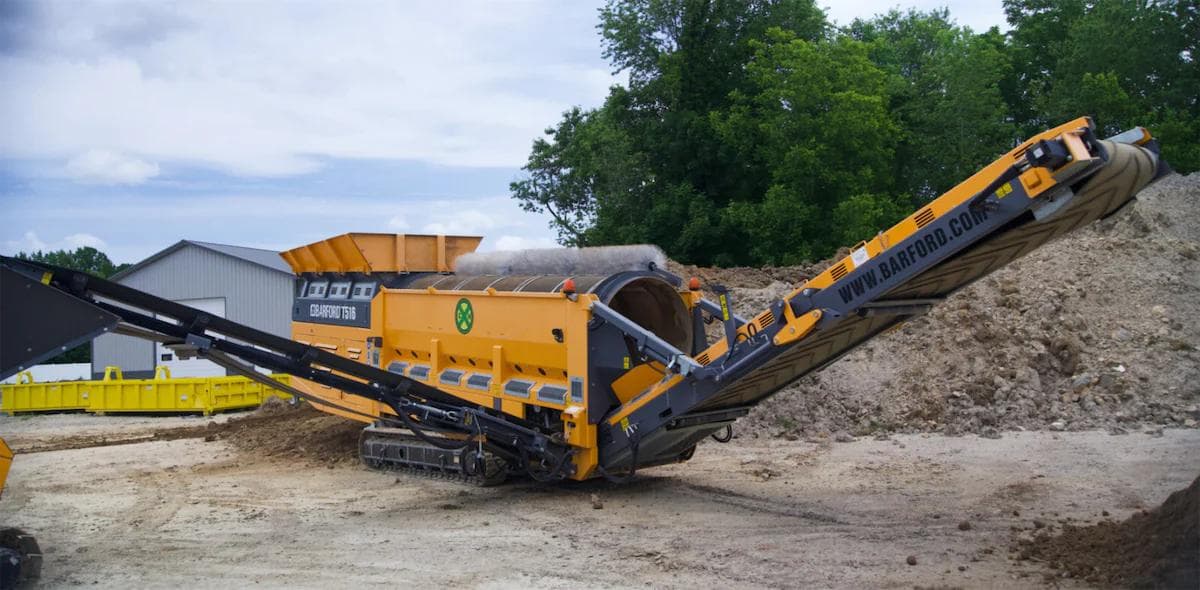
Flat deck screeners work well for dry material like topsoil, gravel, and clean wood compost. For mixed organics, wet inputs, or high-clay soils, a trommel is the more reliable choice. See how trommels compare to flat deck screeners to understand which fits your material.
Wood Chippers and Horizontal Grinders: Storm Debris Without the Trucking Bill
Storm events are expensive for municipalities not because of the cleanup labor but because of what happens after the crews are done cutting. Logs, limbs, and brush pile up at staging areas, and hauling that bulky volume to a disposal site is where the cost spikes.
A towable drum chipper handles limbs and brush up to a certain diameter and converts them into chips on the spot. Chips can go directly into municipal composting, be spread as trail surface or erosion control, or be picked up by landscapers and residents at no cost to the department.
For larger storm events where whole logs and root balls are part of the cleanup, a horizontal grinder handles the volume a chipper cannot. Horizontal grinders process full-diameter logs, stumps, and mixed woody debris into mulch or biomass fuel. Municipalities with land clearing operations alongside storm cleanup find horizontal grinders cover both use cases.
The calculus is simple: grinding or chipping on-site before the trucks load means fewer loads, lighter loads, and more options for where the processed material goes. A material you were paying to haul becomes a material you can use or move for free.
For more detail on commercial chipping equipment, see our industrial wood chippers guide.
Compactors: The Transfer Station Tool That Pays for Itself in Load Count
Stationary compactors and self-contained compactors at transfer stations and public works yards do one thing well: they make waste denser so each truck carries more material per trip.
For municipalities with consistent inbound volumes at a transfer station, a stationary compactor paired with an open-top container eliminates the loose-load inefficiencies that inflate truck counts. General solid waste, cardboard, dry recyclables, and some organic streams all compact effectively.
The payback on a compactor is straightforward to calculate. Take your current weekly truck count for a given waste stream, multiply by your per-trip cost including driver time and fuel, and then model what happens if you reduce trips by 30 to 40 percent. That gap is the machine budget.
For facilities processing multiple waste types, pairing a compactor with a shredder upstream lets you handle virtually any inbound material and control both volume and density before transfer.
Compliance and Permitting: What to Know Before You Buy
Most shredders, trommels, screeners, and compactors for on-site municipal use operate within general industrial equipment guidelines and do not require special environmental permits beyond standard facility compliance.
Air curtain burners are an exception. They are an effective tool for municipalities dealing with large volumes of woody debris, land clearing waste, or storm material in areas where grinding is not practical, but they do require a permit under state air quality regulations and EPA guidelines. The permit process is manageable, and the equipment can operate in most states. Operating near Title V facilities or in specific air quality non-attainment zones requires additional review. If your department is exploring air curtain burners, that permitting step needs to happen early in the planning process. See our air curtain burner compliance guide for a full breakdown.
What Machinery Partner Carries for Municipal Operations
Machinery Partner works with municipalities and public works departments to match equipment to specific waste streams, volumes, and facility configurations. The equipment available for municipal applications includes industrial shredders from Olnova and ARK, compost and green waste shredders, trommel screens, industrial wood chippers, horizontal grinders, stationary and self-contained compactors, and air curtain burners.
Most of these machines are available with flexible financing, and Machinery Partner handles commissioning, training, and ongoing service support so your department is not managing a piece of equipment it did not have the staff to operate.
If you are working with a specific waste stream, a diversion target, or a hauling budget you need to bring down, the right conversation is about your material volumes and your current costs, not the spec sheet. Talk to an expert about your project.


